THE TEARS OF THE VIRGIN

Ordinary Time is punctuated by some of the most beloved feasts of the Blessed Virgin Mary, such as the Assumption on August 15 and the Nativity on September 8. But we also celebrate Mary, Queen of Heaven, on August 22; Our Lady of Sorrows on September 15; the Blessed Virgin of the Rosary on October 7; and the Presentation of Mary on November 22.
There are beautiful artistic depictions of all these commemorations, but what I want to show here is a depiction of everyday life in the home of Nazareth, in hopes of helping us appreciate the Ordinary Time, which is not so ordinary when lived in remembrance of Christ (memoria Christi).
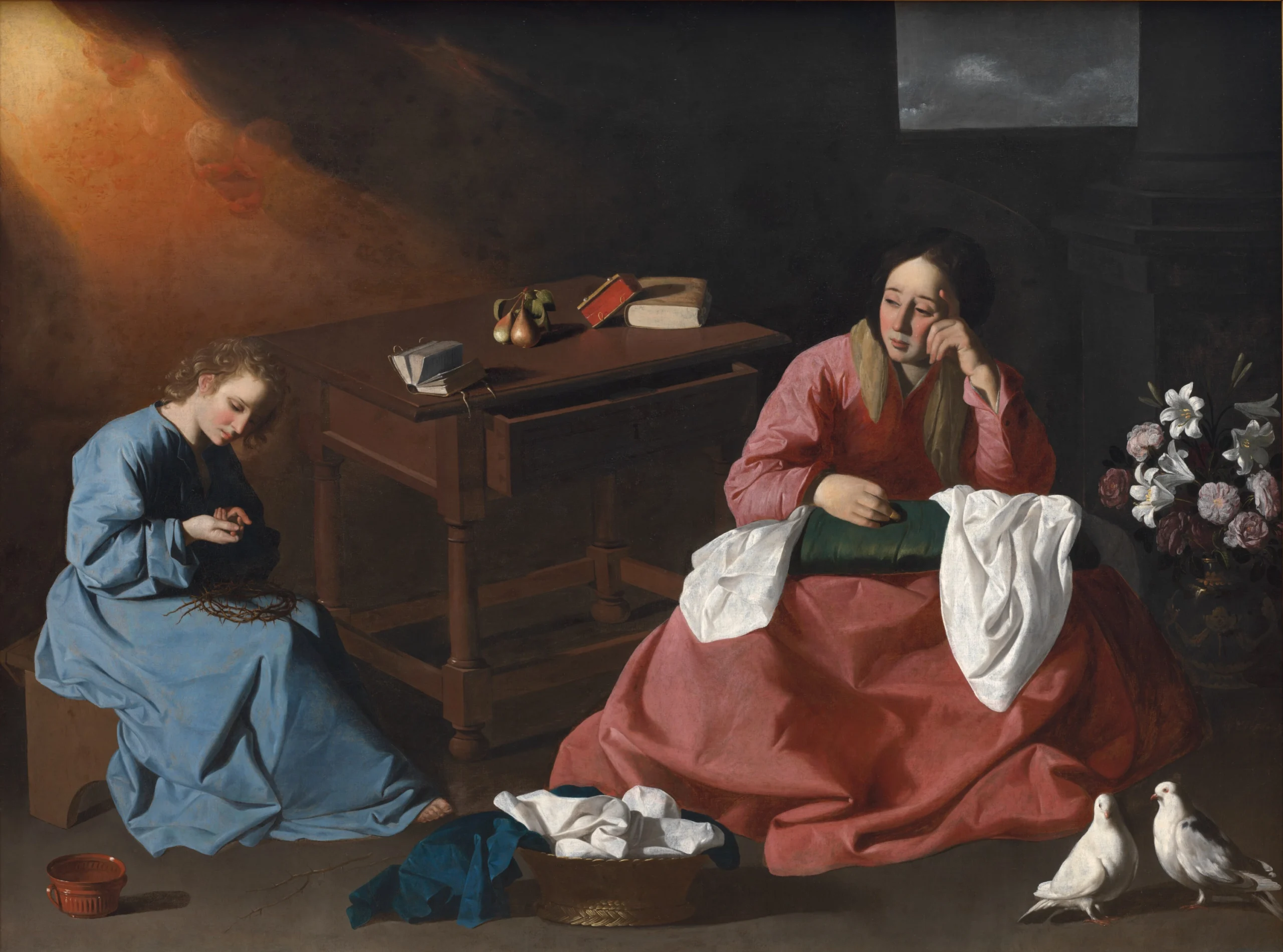
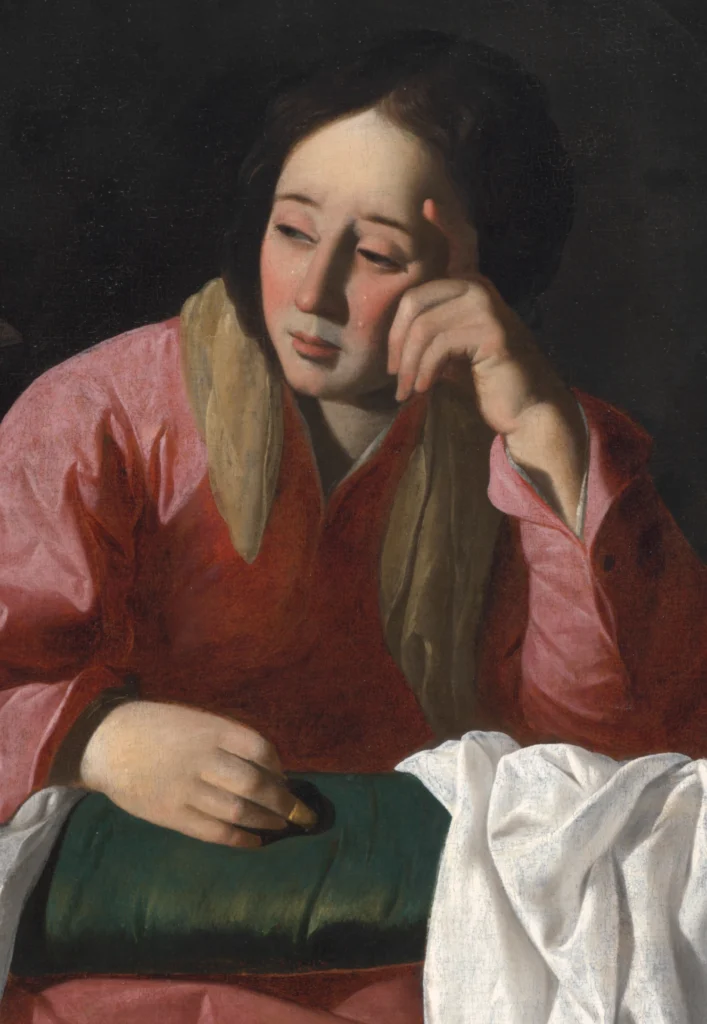
I found the image I was looking for while browsing the Notebook section of Bishop Erik Varden’s website. Bishop Erik calls this work by Francisco de Zurbarán depicting the Virgin Mary contemplating Jesus in the house of Nazareth “a remarkable view.” In this painting, the Virgin is intently looking at the young Jesus weaving a crown of thorns. In this endeavor, Jesus has pricked his finger, and blood is flowing from it. Undoubtedly, the painter presupposes that both Jesus and Mary knew that a crown of thorns would be Jesus’ royal sign during His passion. We know that Jesus knew it because he announced the Passion in detail to his disciples three times during his final journey to Jerusalem. Mary, too, seems to know because the sight of Jesus’ blood brings her to tears.
tears of the virgin smaller

Looking closely at Mary’s face, in fact, we can see that her cheeks are streaked with tears. The mother’s heartbroken expression at the sight of the blood makes us reflect on how deeply her immaculate heart has known the horror caused by our sins. It makes us reflect on the difference between
why Mary weeps and why we weep.

tears closeup2

In an insightful article, Aaron Kheriaty, MD writes about our selfish tears in times of distress:
“In my clinical practice, I frequently see patients who have endured unspeakable evils. They bear an anguish that cannot be communicated or comprehended. Trying to accompany them in their pain has been my daily bread for over twenty years. This professional experience has provided a window into the suffering of the human heart that most people probably cannot access in the same way, at least outside of their own personal experience of suffering. When we suffer, we understandably want to comprehend the reasons for our anguish. My patients often ask, as I ask when I am in pain: Why is this happening to me? Did I do something wrong to deserve this? Is God punishing me? Why is God—who is all good, all-knowing, and all-powerful—allowing me to suffer when He could have prevented it? These questions are perfectly natural. Notice, however, that they all involve asking God to teach me about my suffering…”


Dr. Kheriaty continues arguing that these questions are beyond the capacity of our finite intellect to comprehend, and then warns us that if we do not fix our gaze on Christ’s Cross, any answer to questions about suffering is incomplete or simply wrong. We must learn from Jesus’ suffering and go more deeply into His Passion to find peace. Kheriaty says: “ During my nearly five years of dealing with a severe, debilitating chronic pain condition, […] I wish I had learned sooner to turn my attention to Christ’s Cross rather than focusing on mine. […]  I needed a crucial shift in focus: anything to do with my sufferings puts me at the center instead of God. When I rightly recognize His place, my attention reorients from my own suffering to His. There I can find liberation.” 
Faced with Christ’s suffering, our suffering eventually fades into the background. Mary’s tears convey exactly this truth. She sees her Son’s sufferings. She focuses on His precious blood.
Francisco de Zurbarán was a deeply religious painter who experienced sorrow, too. He experienced the plague that killed half of the population in Seville in 1649. His adult son John, aged only twenty-nine, was among the victims.
Francisco de Zurbarán wants us to see the tears of the Virgin even in the quiet days in her home at Nazareth. He forebodes Mary’s intense participation in the passion of her Son. Mary knew that she couldn’t prevent it. She could only wait in patience and repeat her “Fiat.”
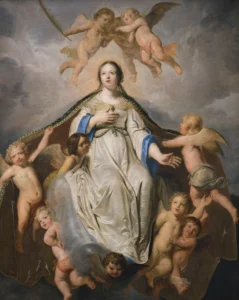
In another work by Francisco de Zurbarán, the Child Mary, surrounded by a cloud of glory, contemplates God. Even in this painting, the girl’s expression is deeply intent and almost tearful. 
Mary’s tears open a window into her pure heart. The purer her heart, the more excruciating her pain from the sins and evil committed by people around her. Sin touches her heart like a sword.
Therefore, Mary’s concern for sinners is so profound that she often intercedes even before the sinner cries out for help when facing temptation. As Dante writes: “…ma molte fiate/ Liberamente al domandar precorre (but many times she freely anticipates the request…). “Blessed are those who weep because they will be consoled.”   ◼

Latest POSTS


SEE ALL ARTICLES
Mary and the Monk

DOM AUGUSTINE ROBERTS, OCSO Where does Mary fit among the many elements of monastic life? [...]

Litany of Mary’s Praises in Blessed Oglerio of Locedio

SR. JULIE ANN PESONGCO,OCSO The Second Vatican Council taught that the authentic renewal of religious [...]

Blessed Joseph-Marie Cassant

MO. AUGUSTA TESCARI, OCSO Except in monastic circles—especially French-speaking ones—Blessed Marie-Joseph Cassant is a very [...]

Mẹ Maria: Reflecting on Vietnamese Marian Devotion

SR. MARTA HA THI THANH THUY I first came to know Our Lady through my [...]

My soul magnifies the Lord!

DOM PAUL MARK SCHWAN, OCSO What elements make up a Cistercian devotion to the Blessed [...]

Mary, Queen of Citeaux

DOM DAVID LAVICH, OCSO We might find it curious to note that the name of [...]

WHO IS BLESSED GABRIELLA?

The step towards the ultimate goal of life always requires a very high act of [...]

SUBSCRIBE TO COLLOQUIUM

GET NOTIFIED WHEN A NEW ISSUE BECOMES AVAILABLE
Dont worry, we don’t spam!