
DOM MARK SCOTT, OCSO
Father Chrysogonus Waddell of Gethsemani Abbey in the US died in November 2008. I had been at Gethsemani a little more than a month, getting established in my new jobs as editor of Cistercian Studies Quarterly and editorial director of Cistercian Publications. I had been given office space on the third floor of the library building, the old lay brothers’ novitiate. Fr. Chrysogonus’s office was on the ground floor of that building. After Fr.Chrysogonus died, the abbot, Dom Elias, asked me to move downstairs and take over Fr. Chrysogonus’s office space. That was fine with the workers who did a great job remodeling that space before I actually moved in. It was there that I spent my work time over the next five years or so.
Fr. Chrysogonus left a lot of things behind. Among these, were several pictuures hanging on the walls. I got rid of all but one of them, a small framed photographic portrait of an early-twentieth-century Trappist abbot. I hung that portrait on the wall to the right of my computer desk, so I always felt this presence looking down at me or watching over me.
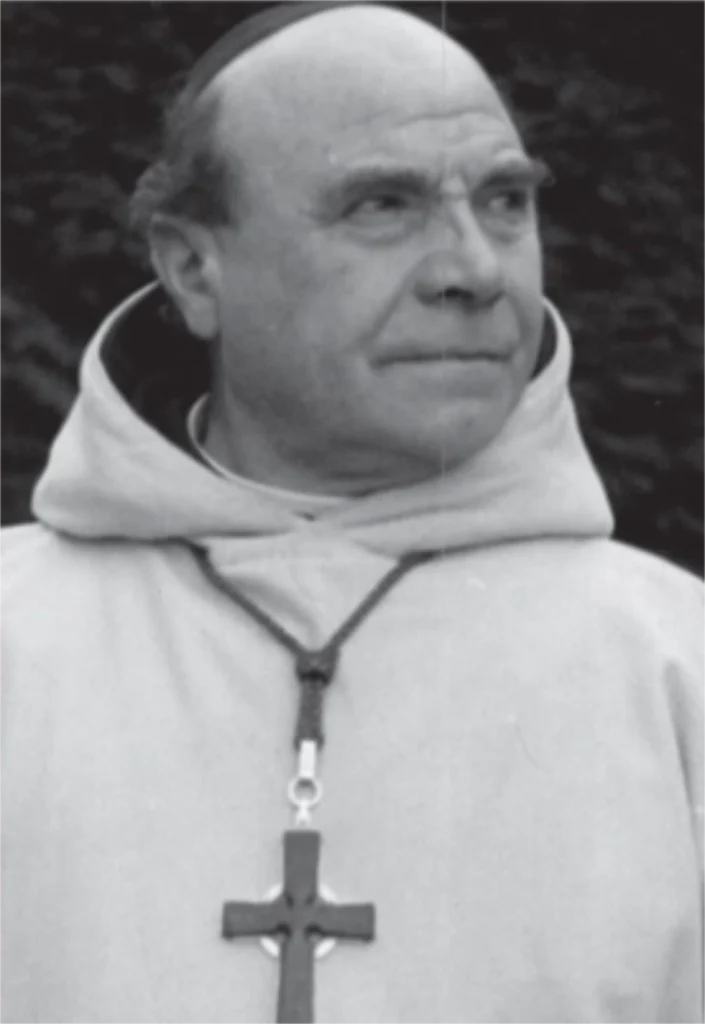
The picture showed this abbot to be strong and forthright. Sometimes he looked to me stern and reproving, other times whimsical and on the verge of laughing at a subtle joke. The abbot in the picture was Anselme Le Bail. He was abbot of Scourmont, Belgium, from 1913 to 1956, when he died at the age of 78. He had been abbot for forty-three years, from the time he was thirty-five, a good deal over half his entire lifetime.
I kept that little photograph in my editor’s office not only as a link with the previous occupant, Fr. Chrysogonus, but also because Dom Anselme Le Bail was the remote founder of the two projects I was involved with in that office space, Cistercian Publications and Cistercian Studies Quarterly (CSQ). In that way, at least, Dom Anselme was the exact opposite of Armand-Jean de Rancé: I refer to Le Bail’s modern critical and pastoral promotion of the spiritual and intellectual patrimony of the Order.
Le Bail was twenty-six when he entered the novitiate of Scourmont, Belgium. At the time, he had been a simple professed member of the Congregation of the Holy Spirit, a missionary order. For whatever reason, he had been dismissed from that congregation, but not without first having done philosophy and theology studies and receiving minor orders. He had also fulfilled his compulsory military service. When Le Bail entered Scourmont in 1904, the abbot, Dom Norbert Sauvage, had been in office for two years. In the convergence of these two men at this time and place, you can see the working of Providence on behalf of the Order for the following century and beyond.
Le Bail’s novice master, also quite new at the job, was Alphonse Bernigaud. He was, it has been said, “no way prepared for that responsibility,” and perhaps it was just as well he wasn’t. At the time, it was customary in the Order to base novitiate formation on the three-volume work of an early-seventeenth-century Spanish Jesuit, Alphonsus Rodriguez, Practice and Perfection of Christian Virtues. Le Bail’s novice director, Alphonse, worked by trial and error to come up with another method. He was certainly encouraged to undertake this exploration of a more specifically monastic formation by his abbot, Dom Norbert. Eventually, Fr. Alphonse hit upon what at the time was a novel idea: why not use the Rule of St. Benedict as a formation manual? The novice Anselme took to this idea with his typical zeal. By the end of his novitiate, he himself had made a huge synthesis of the Rule that he would continue to develop throughout his life as a monk and an abbot. When Le Bail himself became novice master at Scourmont, he, in his turn, based his teaching on the Rule, in addition to forming his novices in liturgy, contemplative prayer, and the interior life.
Anselme’s forty-plus years as abbot of Scourmont began in a way unusual for us but not so strange for the France of the early twentieth century. Less than a year after his election, he was called up again to military service and for six years served as a military chaplain. The time coincided with what we know as World War I. Anselme’s long abbacy also included the inter-war period and then World War II, when all the Scourmont monks under thirty-five were mobilized, about two-thirds of the community. Eventually, even that one-third remnant had to leave until the end of the war, German soldiers having occupied the monastic buildings.
Le Bail was a true Cistercian and monk, yet whatever it was that had led him as a youth to that missionary congregation remained with him. Twice, he was sent by the General Chapter to Congo to help out at Kasanza, a foundation of Westmalie. In 1929, he established some of his monks on the island of Caldey, Wales, in buildings recently abandoned by Benedictine monks. Before the Second World War, as if anticipating Vatican II’s openness to non-Christian religions, Le Bail encouraged the Order to be open to dialogue with the religious traditions of East Asia, even planning a foundation in India for Scourmont. The plan for a foundation in India was put on the shelf when WWII broke out, but it became a reality in 1999 when Kurisumala Ashram was incorporated into the Order. Kurisumala had been founded in 1958 by Fr. Francis Mahieu, a monk under Dom Anselme at Scourmont, who was inspired by his vision of an Indian Christian monastery. Mokoto in Rwanda was founded by Dom Anselme in 1954.
So, there was this missionary part to Anselme Le Bail. But that is not what I saw in that little picture on my office wall. There, he was an abbot, an abba, a father, looking at me as at a son, both wise and playful. In a letter to another abbot, Le Bail quoted a long passage from Saint Bernard’s Letter 732: “All those among yours whom you find sad or lax, or those who have trouble living, know that it is for those that you are Father, that you are abbot… It is precisely so that you may be the source of strength for all that you have been chosen from among them.” As abbot, Dom Anselme continued to be involved in the formation of novices, as he was for the entire community. Besides having discovered how to use the Rule as a spiritual guide, he also emphasized the Liturgy and, probably most important for us today, rediscovered the monastic and spiritual treasures in the Cistercian Fathers. There is no other way to describe it but “odd” that, after over eight hundred years of Cistercian monasticism, the authentic Cistercian patrimony had to be rediscovered only in the middle of the twentieth century, but that’s the case, and it is Le Bail and the monks of Scourmont we have to thank for that retrieval of sources.
Through these sources, Le Bail was able to fashion a monastic humanism. “He wanted the monks to behave as adults and to be eager to develop their own personalities. He wanted to teach them how to think for themselves, how to enter more deeply into the meaning of their monastic life (Veilleux, OCSO 20th Cent, 184). Le Bail wrote, “Cistercian monks should have a zeal for… the Cistercian Fathers… The study of Holy Scriptures according to the commentaries of Saint Bernard, William of Saint-Thierry, Guerric, and Blessed Aelred should, at least once in the lifetime of every monk, extend over a long period… The Cistercian Fathers are perfectly cut out to be our guides. They had the grace, they had the experience… So we should go to them… otherwise we will fall by the wayside or not possess the spirit of our vocation fully.”
Le Bail followed his words with action. He mapped out a detailed project for the publication of the writings of the Cistercian Fathers. It is to this idea, proposed in 1924, that the American Cistercian Publications can trace its own roots; and in 1934, the first issue of the review Collectanea appeared, another child of Anselme Le Bail. Collectanea was followed, in 1965, by its English-language complement, Cistercian Studies [Quarterly]. That is how I could say that Le Bail was the remote founder of the two editing projects I did in that little office at Gethsemani.
We just spoke about Rancé. Le Bail wrote to someone, “You know that I am not a Rancé man.” In another letter, he says, “The great lords of the Order don’t approve of our freedom here at Chimay [i. e., Scourmont] to learn everything and say everything. … All right! We are lax. So let them pray for our conversion. Personally, I forgot this shabby meanness by smoking a good cigar at night under the stars…. while thinking that there are people who pray that I will become a good monk again.”
