
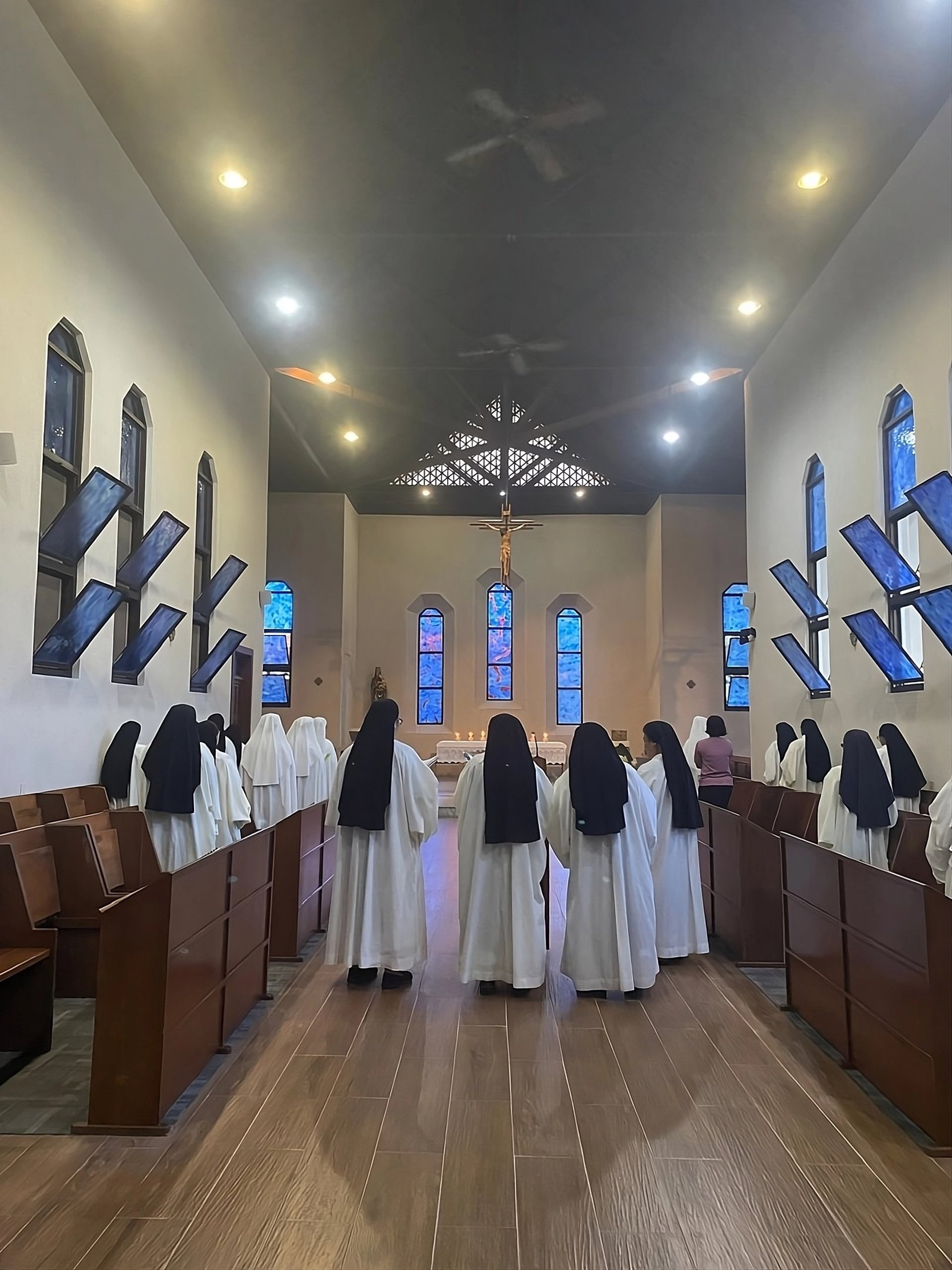
On Prayer
Prayer is really a historical commitment: only truly contemplative men and women are able to speak a new word with their lives every day. Only men and women of prayer discover God’s passage in history; only they know how to read the signs of the times in a perspective of salvation. This is the fruit of prayer that helps us embrace this time given to us, happy to be born today, grateful for this moment in history, happy with our personal history. Prayer generates gratitude for the story we are given
EXPERIENCE
Mo. Cristiana Piccardo, OCSO
Vigils
In the book “Lord, Teach us to Pray," Dom André Louf says that he found this prayer in the Syrian liturgy for a monk’s funeral: “During the watches of the night, his eyelids bore the heavy sleep of the world. May the Light without sunset now shine in his eyes.”
Dom André brings forth two parallel themes: loneliness and wakefulness. Solitude puts man in a different relationship with the world; it changes his relationship with things. Whoever enters solitude has the impression of no longer having roots on earth, of being a stranger, in exile, a pilgrim, outside the world of others, and on the march toward the unknown as its fruit. He speaks of the experience of the desert in terms of “dereliction, frustration,” etc. But, he also says that we must not escape this reality, but allow ourselves to be macerated by it to the end, so that the desert can flourish. The fruit of the desert is emptiness, the abyss of one’s own destitution, the only experience that can put us before God.
God is the great “absentee” in this experience of loneliness precisely because, through this, God helps us overcome the all-too-human patterns we make of Him. When spiritual teachers talk about the alternation of dryness and fervor, they do not at all deny that dryness is also needed. It is precisely the experience of God in His transcendence, while fervor brings us closer to Jesus in His humanity.
Loneliness induces man to wait and makes him experience his own death. Psalm 62 also speaks of a “parched land, parched, without water.” Through loneliness, man becomes the beggar of God's tenderness. The man who is an outstretched hand toward salvation does not weep, does not complain, but lives in silence and obedience, with all his being reaching out to God. This enables him to find his deepest essence: the name which the Lord alone knows and of which Revelation speaks.
Isaac the Syrian, speaking to some spiritual fathers, said, “Do not allow anyone to undertake the smallest monastic asceticism if he has not first experienced for a long time the trial of solitude. One must first become a beggar of God.”
The same thing applies to vigils. Vigils is an unusual way of experiencing the natural alternation of days and nights. In fact, each day and night allows us to take a step forward in time, bringing us closer to the return of Christ and the coming of his Kingdom. In Revelation, Jesus is called “He who was, who is, and who is to come” (Rev. 1:4; 1:8; 4:8; …). This implies the past, the present, and the future. But when we use the future for Him, we do not say, “who will come,” but “who is coming,” because His future is already present.
St. Mark reminds us: we do not know when this hour will come, but it will certainly also coincide with the hour of the supreme trial. Vigils cannot be explained without prayer; without it, it would be meaningless. In the monastic tradition, vigils is oriented toward the expectation of Christ's return, which must find us with an alert heart. Indeed, the monk’s vigil fits into the alternation of days and nights as a sacrament of Jesus’ coming, as a foretaste of what time will bestow in its fullness.
After Christ, even time takes on another meaning. Night is a sign of His absence, and Day, the coming of the Light, of His own coming. Indeed, it is no accident that our churches are oriented toward the east to receive the light of the rising sun. He who abides in the vigil abides in the unfolding of time originally and hastens the coming of the Lord. He is situated on the boundaries between time and eternity. For the one who watches, Jesus has already come, but he still awaits Jesus’ eternal return.
Watching, says Dom André, is one of the most precious things to find the path back to one's heart (in us there is a “deep” heart where we never get to; only by allowing ourselves to be caught up in the waiting of the night do we return to our secret heart, the source of the truth of our being).
The monk who keeps watch briefly finds himself in the arms of Jesus, as Isaac the Syrian says, and becomes like angels, referred to as "watchers" in his Semitic language. And again, “the heart that struggles in the vigil will receive the eye of a cherubim and will contemplate Heaven uninterruptedly.”
We are fortunate because our religious life allows us to physically experience what the soul experiences: the dimension of waiting for the Light, for His coming.
This allows us to penetrate intimately into the very rhythm of the cosmos, into the depths of matter, revealing the mystery that animates it.
Prayer and Mission
What we are asked to live is the return to our God. And the way to live out this return is to “watch and pray.” Cardinal Pironio says that a renewed community commits itself to continuous prayer. Today's generations are dominated by the search for interiority, the hunger for contemplation, the desire for God. This great tension, of which perhaps the man of today is not fully aware, is nevertheless not an evasion from history, or of one’s mission and service to one’s brothers and sisters.
Prayer is the way to realize more authentically the dimension of our mission in our lives. Prayer is really a historical commitment: only truly contemplative men and women are able to speak a new word with their lives every day. Only men and women of prayer discover God’s passage in history; only they know how to read the signs of the times in a perspective of salvation. This is the fruit of prayer that helps us embrace this time given to us, happy to be born today, grateful for this moment in history, happy with our personal history. Prayer generates gratitude for the story we are given. Ingratitude alters prayer and violates the given moment. Entering one's story is the condition for listening to God’s steps. We must remember the great facts - not the feelings that have come upon us - the great facts of God in our lives. For the persons who enter into their own story, it is impossible not to hear and recognize the step of God, the incarnation of God in the texture of their own flesh. It is they who enter into their own story and remain there until the end who are building today, who are building the Church.

Contact
clqm@trappistinesmatutum.org secretariatmatutum@gmail.com
+63 939 283 0835
© 2025. All rights reserved.


Colloquium
Our Lady of Mt. Matutum
Trappistine Monastery
9504 South Cotabato, Philippines